
Last updated: April 2026
On 1 April 2026 — no fooling — humanity returned to the Moon for the first time since 1972. And strapped to the wrists of the four astronauts boarding the Orion spacecraft at Kennedy Space Center were some of the most carefully chosen, historically loaded, and frankly fascinating watches ever worn in orbit. Two brands. Multiple watches per wrist. One of the most elegant — and calculated — pieces of product placement the luxury watch industry has ever executed.
This is the watch story of NASA’s Artemis II mission — and it is considerably more interesting than “Omega made it to the Moon again.”

The Artemis II Crew and Their Mission
Before we get to the watches, a quick scene-setter. Artemis II carried four astronauts: Commander Reid Wiseman (NASA), Pilot Victor Glover (NASA), Mission Specialist Christina Koch (NASA), and Mission Specialist Jeremy Hansen (Canadian Space Agency). Their Orion spacecraft looped around the Moon — the first crewed lunar flyby since Apollo 17 — before splashing down in the Pacific Ocean near San Diego. No lunar landing. But every human being on that ship was further from Earth than any person had been in over fifty years. What they wore on their wrists, then, carries a particular kind of weight.

The Official Watch: Omega Speedmaster X-33 Generation 2
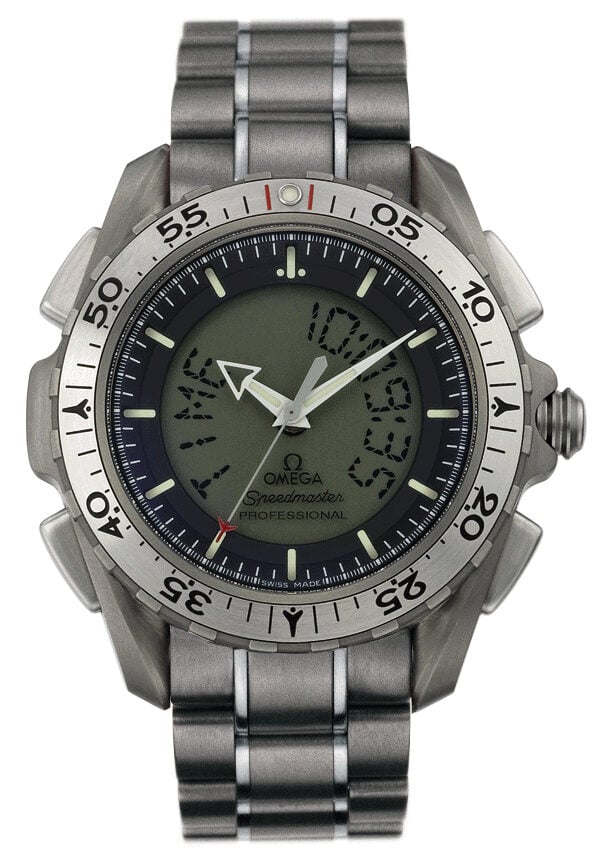
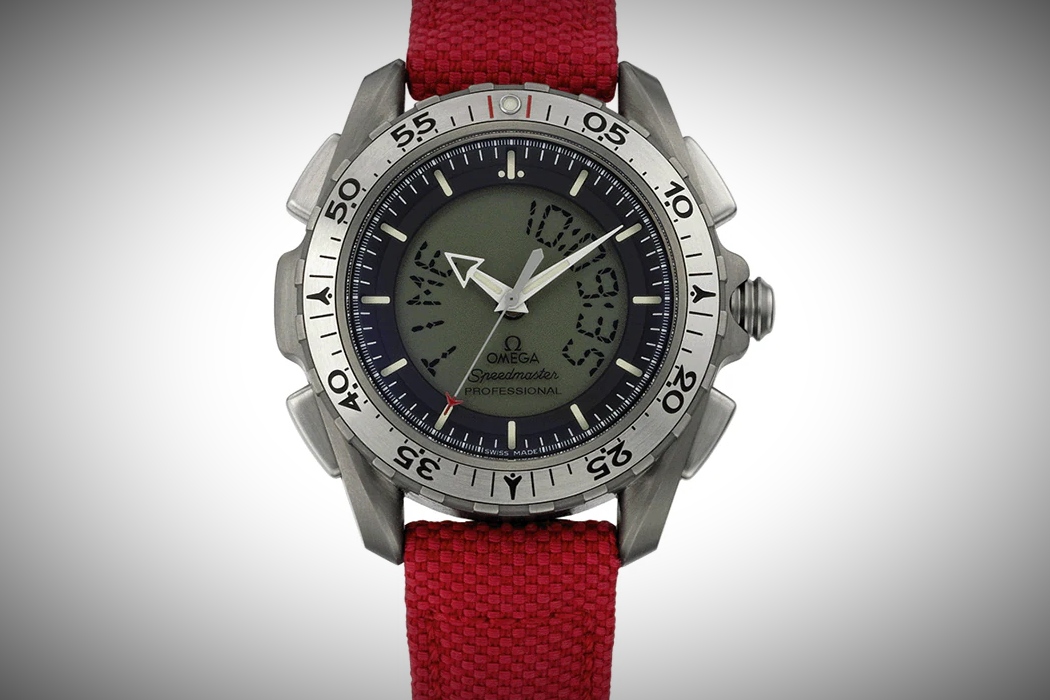
Here is the first thing that surprises most people: it was not the legendary Speedmaster Moonwatch that the Artemis II crew wore to the launchpad. It was its lesser-known sibling — the Omega Speedmaster Professional X-33, second generation, reference 318.92.42.79.01.001.
All four astronauts wore them strapped over the outside of their bright orange launch suits on long Kevlar extender straps — no velcro, just a classic pin buckle. It is a strangely human detail. Fifty-plus years of spaceflight technology, and the humble tang buckle endures.
What is the X-33? Introduced in 1998 after Omega sent prototypes to NASA in 1995, the X-33 was built specifically for modern astronauts. Unlike the hand-wound mechanical Moonwatch, the X-33 runs on an advanced quartz calibre and features an analog-digital display — traditional hands over an LCD screen capable of showing Mission Elapsed Time, UTC, a perpetual calendar, multiple time zones, and alarms that reach a genuinely remarkable 80 decibels. It is, in other words, a wrist-worn mission computer. A 2013 US government document formally described it as “the watch of choice for U.S. astronauts.”
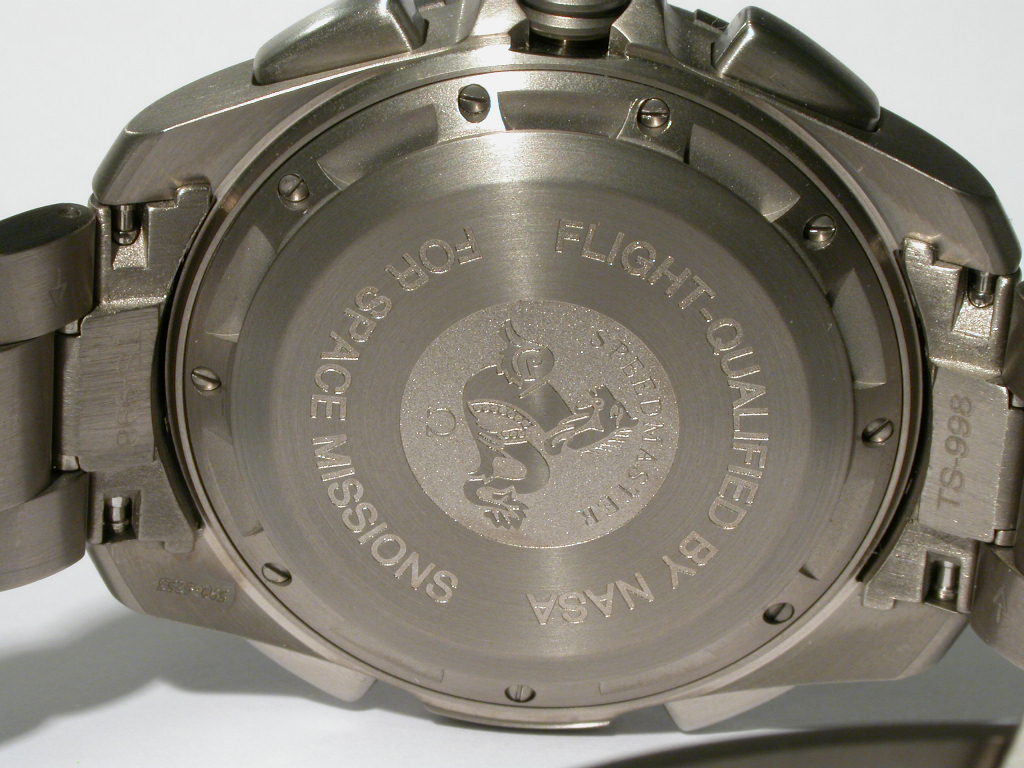
The second-generation X-33 addressed an early problem: the original’s polished bezel and pushers created glare from unfiltered sunlight in orbit. The Gen 2 fixed this with fully brushed surfaces and a revised crown. The caseback carries an engraving that functions almost as a badge of honour: “Flight-Qualified by NASA for Space Missions.” Interestingly, Omega has since produced a third-generation X-33 — the Skywalker, with a ceramic bezel and negative LCD display — but astronauts simply never took to it. The Gen 2 remained the standard issue. Habit, trust, and the conservatism of people whose lives depend on their equipment are a powerful combination.
One outlier worth noting: Pilot Victor Glover was the only crew member spotted wearing his X-33 on its titanium bracelet rather than the standard Kevlar strap. A small personalisation — but the kind of detail that watch enthusiasts notice immediately, and that confirms these astronauts think about their watches in the same way serious collectors do.
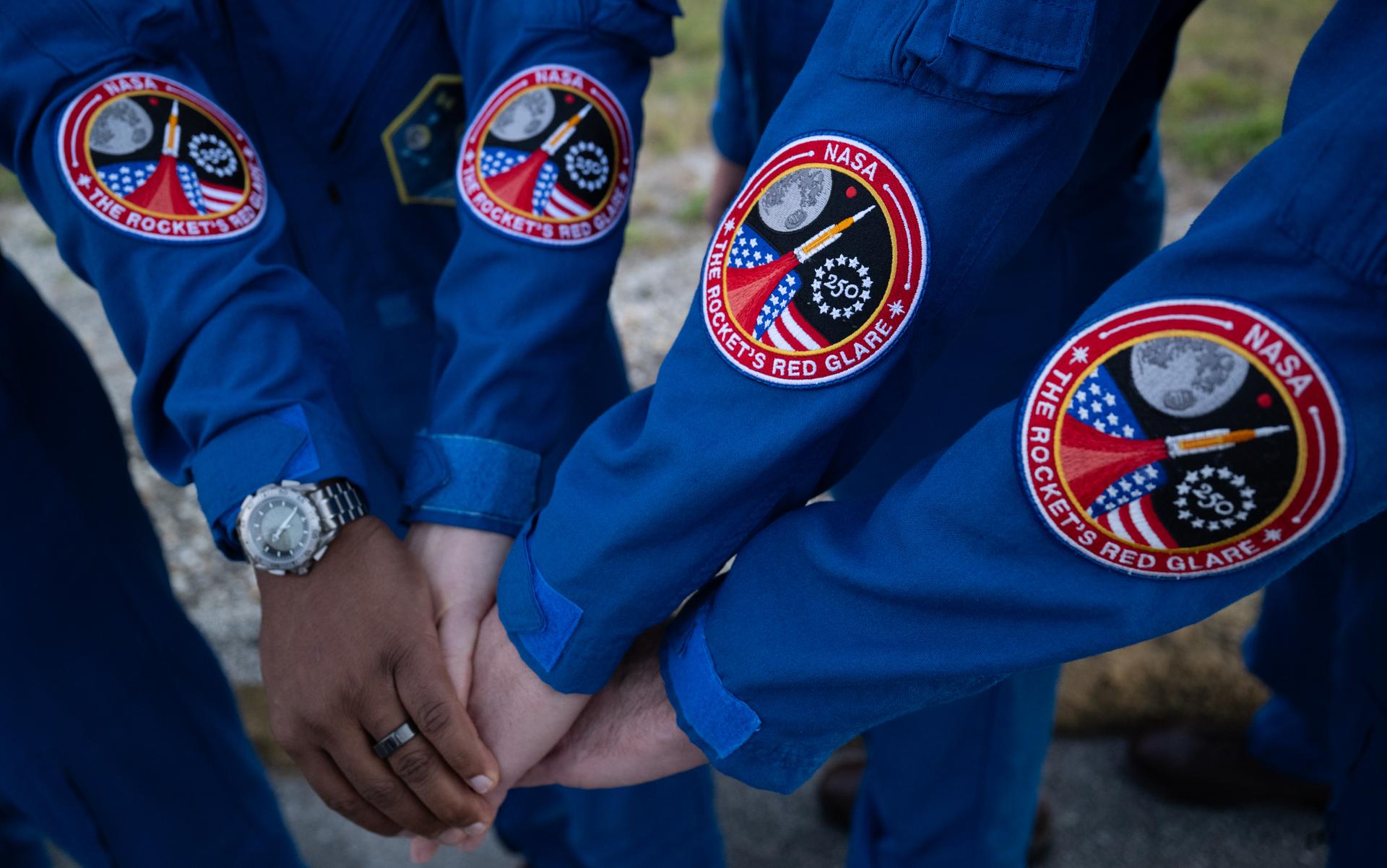
Was it paid placement? The X-33s worn on launch day are almost certainly NASA government property. NASA is known to reclaim issued watches immediately after missions — though astronauts can sometimes purchase their own through official channels. The placement is best understood as institutional: Omega has held NASA flight-qualification status since 1965 (when the Moonwatch ref. 105.003 became the first NASA Flight-Qualified watch) and has maintained it ever since. This is not a one-off sponsorship deal. It is a sixty-year relationship baked into federal procurement policy.
Why Astronauts Were Wearing Two (and Three, and Four) Watches
This is where things get genuinely interesting — and where a parallel story, considerably more commercially calculated, unfolds.
On 27 March 2026, five days before launch, Commander Reid Wiseman appeared at a pre-flight press conference wearing something unexpected on his wrist: a Breitling Navitimer Cosmonaute chronograph. Unreleased. No announcement. Just there, on the wrist of the man about to command humanity’s return to the Moon.

Within days, eagle-eyed watchers of the NASA livestream spotted the same watch — or very similar models — on the right wrists of all four astronauts, worn simultaneously with their issued Omega X-33s. Double-wristing. In some shots, Christina Koch was spotted with three watches on one wrist and one on the other — a combination of her Omega X-33, a Breitling Navitimer, her father’s personal Speedmaster Moonwatch, and the NASA ActiWatch health monitor. The watch forums did not remain calm.
So why multiple watches? Several reasons, some practical and one nakedly commercial.
The ActiWatch — spotted on some crew members — is not a luxury item at all. It is the NASA ARCHeR (Actigraphy and Reaction Card) device, a scientific instrument measuring sleep quality, circadian rhythms, and reaction time in microgravity. It looks like a smartwatch. It is in fact a medical research tool. Astronauts on long-duration missions have worn actigraphy monitors for years. Christina Koch, who holds the record for the longest single spaceflight by a woman (328 days, 2019–2020), is well accustomed to the health-monitoring protocols that come with extended spaceflight.

The personal watches — including Speedmaster Moonwatches brought by multiple crew members — are partly sentimental and partly financial. Koch brought her father’s Moonwatch. Glover reportedly visited the Houston Omega boutique shortly before the mission to purchase a new Speedmaster Professional with calibre 3861, which he confirmed was going along for the ride. Hansen had a Speedmaster Dark Side of the Moon aboard. A watch that has travelled to lunar distance carries provenance that no certificate of authenticity can manufacture. The phrase “space-flown” adds measurable value to a timepiece at auction — and these astronauts, like those before them, are not unaware of that fact.
The Breitling, however, is a different story entirely.
The Breitling Guerrilla Play: Cosmonaute on the Moon
What Breitling pulled off with Artemis II is one of the more sophisticated product placement operations in recent watch industry history. And it began not with a press release, but with a wrist shot at a quarantine press conference.
The watch the crew was wearing — worn on the right wrist alongside NASA’s official left-wrist X-33s — turned out to be a then-unreleased reference: the Navitimer B02 Chronograph 41 Cosmonaute Artemis II (ref. AB02307A1C1P1). Breitling kept the product entirely under wraps throughout the mission. No announcement. No press materials. Just the watches on astronaut wrists, generating organic media coverage and watch forum hysteria for ten days. The reveal came after splashdown, perfectly timed for Watches and Wonders Geneva 2026 — the industry’s most prestigious annual showcase, running April 14–20.

It is worth noting: during the mission itself, astronauts are prohibited from entering commercial endorsement agreements with brands. Everything that Breitling achieved on those wrists was built on personal relationships, historical resonance, and one specific request. According to reporting from Gear Patrol, the project began when Mission Commander Reid Wiseman personally requested a Cosmonaute — specifically to honour the original’s place in spaceflight history.
What is the Cosmonaute? In 1962, NASA astronaut Scott Carpenter was preparing for his Mercury-Atlas 7 mission aboard Aurora 7. He was a Navitimer fan — its computational slide rule bezel was familiar from his days as a naval aviator. But he had a problem: in orbit, where the sun rises and sets every ninety minutes, a standard 12-hour dial becomes confusing and potentially dangerous. He asked Breitling to build him a 24-hour version. They did. On 24 May 1962, Carpenter orbited Earth three times wearing that custom Navitimer — and it became the first Swiss wristwatch ever worn in space. Breitling named it the Cosmonaute.
The 2026 limited edition honours that legacy with considerable style. The new Cosmonaute Artemis II features:

A 41mm stainless steel case. A galaxy-blue meteorite dial — cut from actual extraterrestrial rock, acid-etched to reveal its natural Widmanstätten crystalline pattern, meaning no two dials are identical. The manual-wind Breitling Manufacture Calibre B02, COSC-certified, with a 70-hour power reserve and a 24-hour display. The Artemis II mission insignia embossed on the open caseback, alongside individual numbering. Just 450 pieces, at a retail price of $11,900 (€11,750 / £9,500).

The timing of the release — days after splashdown, days before Watches and Wonders — was not accidental. Breitling had the watches on lunar-distance wrists for ten days, then unveiled the product to an industry already gathered in Geneva and a media cycle hungry for a story. It is, as Watches of Espionage put it, “a carefully orchestrated guerrilla marketing campaign.” One that cost nothing in traditional advertising and generated global coverage.
Omega vs Breitling: The Watch on Every Wrist
| Brand | Model | Role on Artemis II | Placement Type | Retail Price | Limited? |
|---|---|---|---|---|---|
| Omega | Speedmaster X-33 Gen 2 | Official NASA-issued mission watch (all 4 crew) | Institutional / government-qualified | Not available to public | No |
| Omega | Speedmaster Professional (various) | Personal watches, taken aboard individually | Personal / aspirational | ~$6,300–$9,500+ | No |
| Breitling | Navitimer B02 Cosmonaute Artemis II | Worn on right wrist alongside X-33 (all 4 crew, in cabin) | Organic / guerrilla marketing | $11,900 | 450 pieces |
| NASA | ActiWatch / ARCHeR device | Medical research monitor — sleep, circadian rhythms | Scientific equipment | N/A | N/A |
Why Space Is the Ultimate Product Placement — and Always Has Been
Let’s be direct about what makes space placement different from every other form of brand association in existence.
A watch worn at the Oscars is an elegant piece of marketing. A watch worn in a blockbuster film creates genuine pop-culture association. But a watch worn 270,000 miles from Earth, on the wrist of someone travelling further into space than any human being has in over half a century? That is not placement. That is history. And history is the one thing that no amount of media spend can buy once the window closes.
For watch brands specifically, the logic is unusually pure:
1. Authenticity at impossible scale. The watch industry’s central promise is precision under pressure. What greater demonstration exists than a timepiece functioning in the radiation environment of deep space, at temperatures ranging from +120°C in sunlight to -100°C in shadow, while travelling at 24,500 miles per hour? No laboratory test communicates what a single space mission communicates.
2. Permanence. Omega has been “the Moon watch” in the public imagination since 1969. That association is built into the product’s name. It has outlasted every advertising campaign the brand has ever run. Breitling was the first Swiss watch in space — 1962 — and that fact now appears prominently on press releases, product descriptions, and boutique walls sixty-four years later. Space placement does not depreciate.
3. The “space-flown” premium. Watches carried on space missions — even as personal items — acquire measurable resale value. The watch community understands this. The astronauts understand this. It is not cynical. It is simply a recognition that objects with documented extraordinary history are extraordinary objects.
4. Global media with no production budget. The Artemis II launch was watched by millions. Every NASA press conference, every livestream from inside the Orion capsule, every photograph released by NASA — all of it broadcast the watches on those wrists to an audience no 30-second television spot could reach. And the credibility of that imagery is total: these are real astronauts, doing something genuinely historic, wearing these watches because they chose to.
The timing of Breitling’s reveal — just before Watches and Wonders, the industry’s most-watched annual event — added a final layer. The brand arrived in Geneva with astronaut photography, a compelling historical narrative, and a sold-out limited edition. In a world where watch brands compete ferociously for editorial attention and collector interest, Breitling walked into the room holding the Moon.
The Moonwatch Question: Will It Return for Artemis IV?
One detail that watch enthusiasts noted immediately about Artemis II: the original hand-wound Speedmaster Professional Moonwatch was conspicuously absent from the launch-day wrists. It remains the only watch ever NASA-qualified for extravehicular activity — EVA, meaning any time an astronaut leaves the spacecraft, whether in open space or on the lunar surface. The X-33, despite its flight qualification, does not hold EVA status. Artemis II had no EVA component, which is why the X-33 was sufficient.
But Artemis IV — currently anticipated for 2028 — is expected to include an actual Moon landing. If that mission proceeds, the original Speedmaster Professional will almost certainly return to the lunar surface for the first time since Apollo 17 in 1972. The Moonwatch would go back to the Moon. As a brand story, that is almost impossible to overstate. Omega is, quietly, sitting on one of the most significant marketing moments in the company’s history — and the only question is whether the mission timeline holds.
A Brief History of Watches in Space — The Context That Makes Artemis Matter
To understand why watch brands care so much about space, it helps to understand how it started.
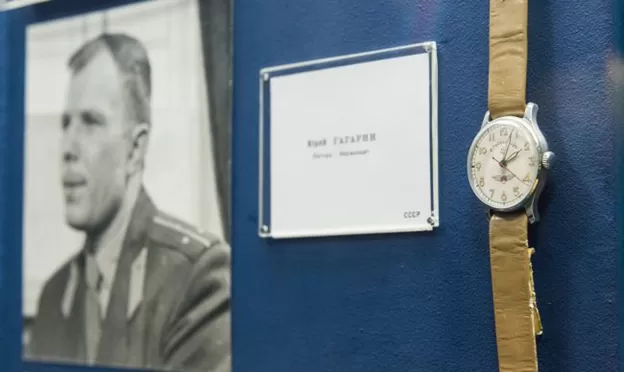
1961: Soviet cosmonaut Yuri Gagarin wears a Sturmanskie during Vostok 1 — the first human spaceflight. The Sturmanskie becomes the first watch in space, full stop.
1962: Scott Carpenter requests a 24-hour Navitimer from Breitling for Mercury-Atlas 7. The Cosmonaute is born. First Swiss watch in space.

1965: NASA flight-qualifies the Omega Speedmaster Professional ref. 105.003 after rigorous testing. It becomes official astronaut equipment.
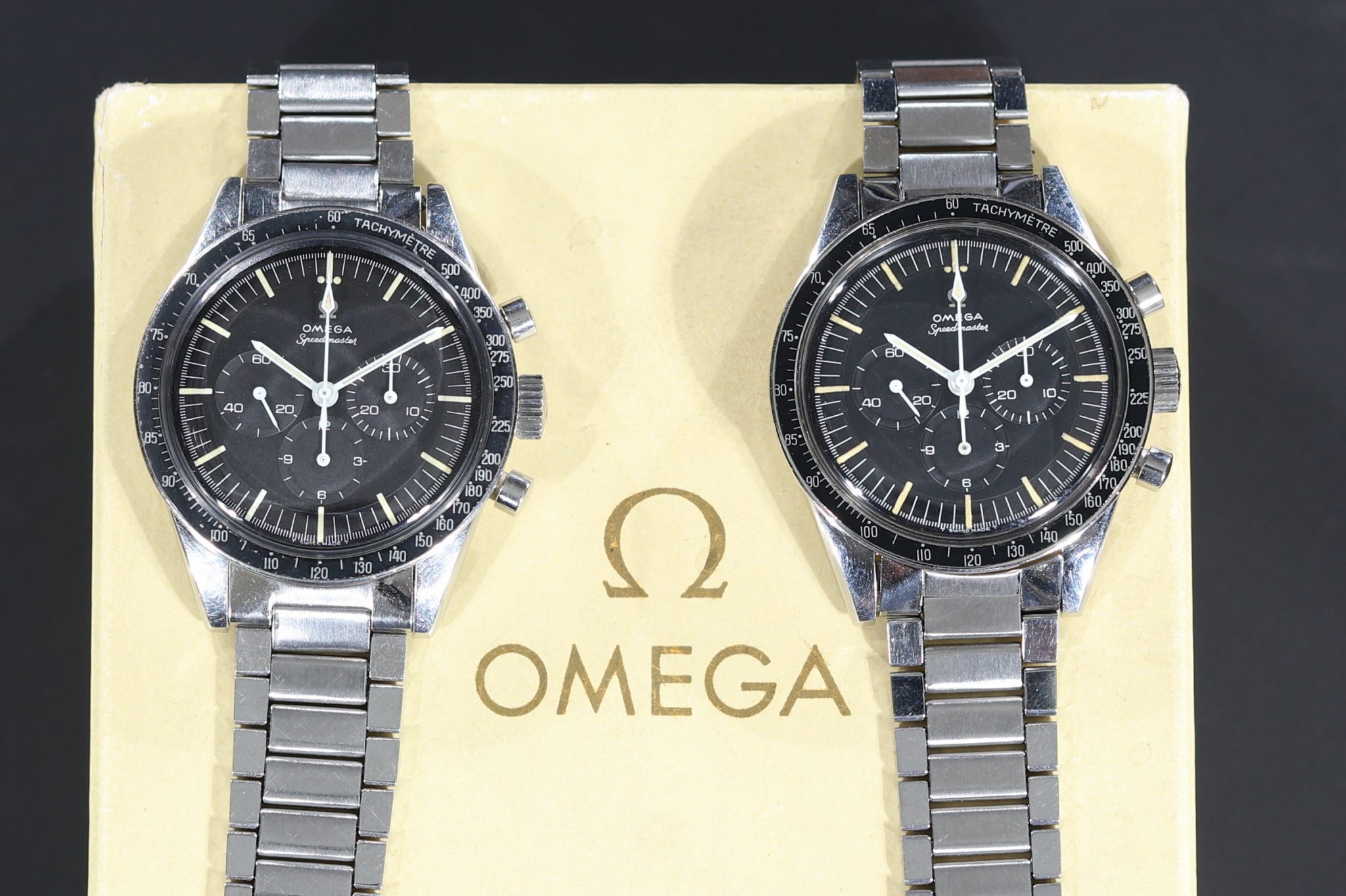
1969: Neil Armstrong and Buzz Aldrin land on the Moon. Aldrin wears his Speedmaster on the lunar surface (Armstrong left his inside as a backup timer after the onboard clock malfunctioned). The “Moonwatch” designation is born.
1998: Omega introduces the Speedmaster X-33, designed with Space Shuttle astronauts for modern mission requirements. It receives NASA flight qualification — making it only the second Omega watch ever to achieve that status.
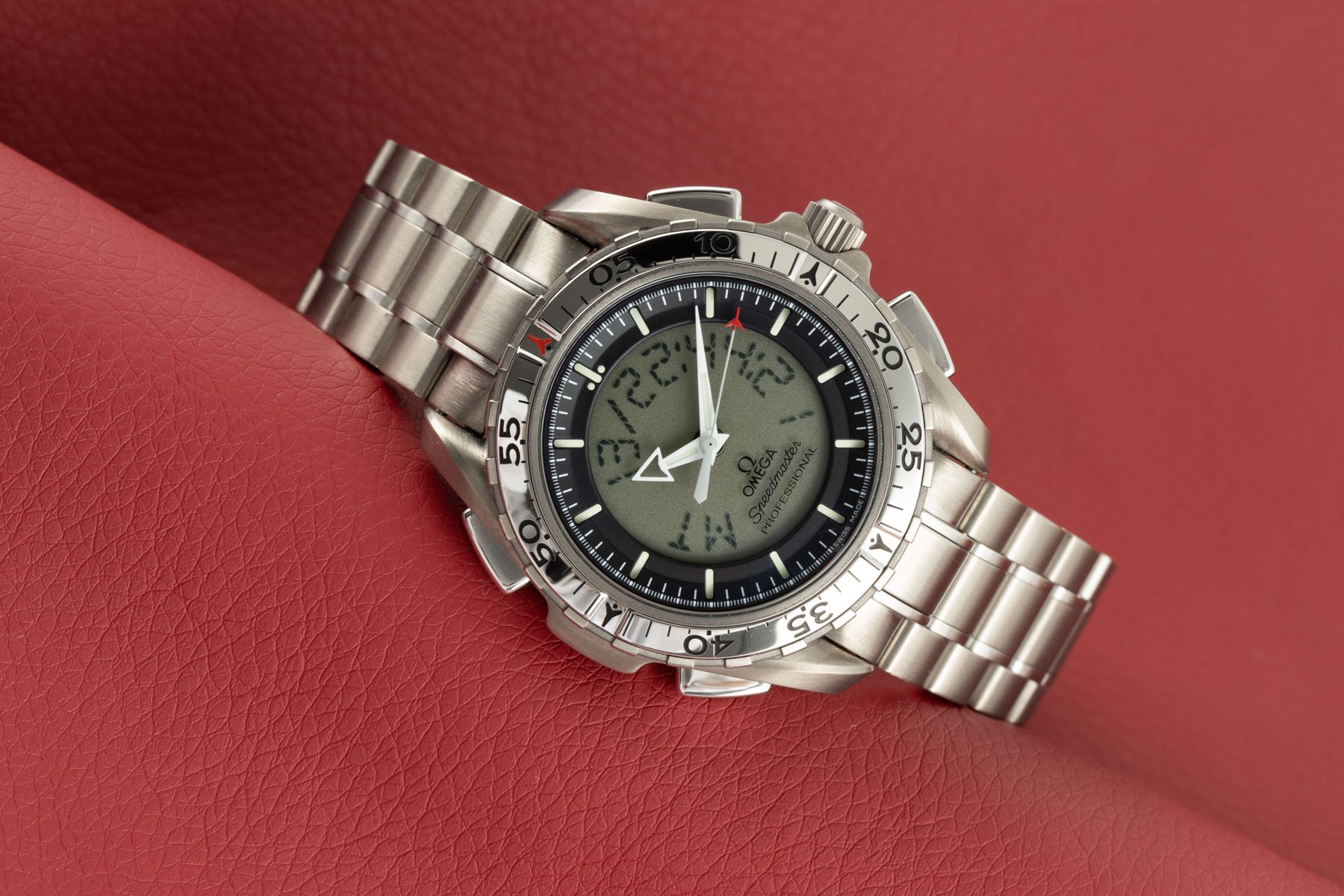
2026: Artemis II. The X-33 is the official mission watch. The Cosmonaute returns to lunar distance for the first time in sixty-four years. And the watch industry’s relationship with space gets a new chapter.
What It Signals — And Did It Work?
For Omega: The institutional position is reinforced and deepened. The X-33’s profile has been dramatically elevated — a watch not available to the public for two decades is now the most-photographed watch of 2026. And the Moonwatch’s return to lunar EVA duty on Artemis IV, if it happens, would be a marketing event of almost unmatched significance. The Artemis II association costs Omega nothing in new product development. It costs them a relationship maintained over sixty years. The return on that investment, measured in editorial coverage and brand equity alone, is extraordinary.
For Breitling: The Cosmonaute Artemis II is limited to 450 pieces at $11,900. At full retail, that is roughly $5.3 million in sales — before the secondary market premium that mission association will add. But the commercial impact of the limited edition is almost secondary. The real gain is the reclamation of a narrative that had been dormant. Breitling was the first Swiss watch in space. In 2026, it is the watch the astronauts chose to wear in addition to their issued equipment. That distinction — personal choice, not official issue — is arguably more powerful. You do not take something to the Moon unless you want it there.
One placement that genuinely surprised me in the ongoing coverage: Christina Koch wearing her father’s Moonwatch. It is entirely personal, entirely unsponsored, and entirely unrepeatable. No brand could have planned it. And it is possibly the most moving watch story to emerge from the mission — a woman carrying a piece of family history to lunar distance and bringing it home.
The Bottom Line
Artemis II is the most concentrated watch placement event since the Apollo programme. Two brands. Multiple watches per wrist. One of the most precisely timed limited-edition reveals in modern product marketing. And underneath all of it, the same simple truth that has animated every space-watch story since Gagarin: in a place where everything is extraordinary and nothing is guaranteed, the watch on your wrist is one of the most human things you carry.
Omega keeps the Moon. Breitling reclaims the stars. And somewhere between the X-33’s mission timers and the Cosmonaute’s meteorite dial, the watch industry just reminded itself — and everyone watching — why space placement is the one no other medium can replicate.
All four Artemis II astronauts — Reid Wiseman, Victor Glover, Christina Koch, and Jeremy Hansen — wore the Omega Speedmaster X-33 Generation 2 as their official NASA-issued mission watch. Additionally, all four crew members were spotted wearing the then-unreleased Breitling Navitimer B02 Cosmonaute Artemis II inside the Orion capsule. Some crew members also carried personal Speedmaster Moonwatches and medical ActiWatch devices.
Multiple reasons. The Omega X-33 was the official NASA-issued mission watch, worn on the left wrist. The Breitling Navitimer Cosmonaute was a personal choice — and part of an organised, if unofficial, brand partnership timed to launch alongside Watches and Wonders Geneva 2026. Some crew also wore NASA’s ARCHeR ActiWatch, a medical device monitoring sleep and circadian rhythms in space. Personal Speedmaster Moonwatches were also brought aboard as private items — a “space-flown” watch carries significant provenance and resale value.
Yes. The Omega Speedmaster X-33 Generation 2 remains NASA’s flight-qualified watch for use aboard spacecraft, a status it has held since 1998. The hand-wound Speedmaster Professional (Moonwatch) remains the only watch ever NASA-qualified for extravehicular activity (EVA). For the Artemis IV lunar landing mission, expected around 2028, the Moonwatch is expected to return to the lunar surface.
The Breitling Navitimer B02 Chronograph 41 Cosmonaute Artemis II (ref. AB02307A1C1P1) is a limited edition of 450 pieces released following the mission’s splashdown. It features a 41mm stainless steel case, a blue meteorite dial (cut from actual extraterrestrial rock), a 24-hour display, and the manual-wind Calibre B02 with 70-hour power reserve. The Artemis II mission insignia is engraved on the open caseback. It retails for $11,900 (€11,750 / £9,500).
Not in the conventional sense. Astronauts are prohibited from entering commercial agreements during active missions. The Breitling placement is best described as a “guerrilla marketing campaign” — the watches were gifted to crew members as personal items, appearing organically in NASA imagery and live streams throughout the mission. Breitling withheld any product announcement until after splashdown, timing the reveal to coincide with Watches and Wonders Geneva 2026 for maximum industry impact.